Plausible by Default: How Machine-Written Pages Become Institutional Fact
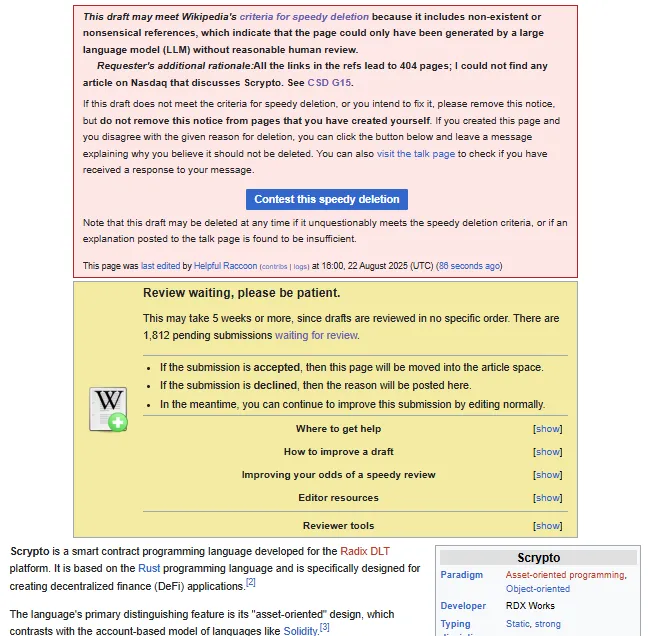
Photo: Wikipedia contributors, CC BY-SA 4.0, via Wikimedia Commons
The scenario is by now routine in 2026. A knowledge base has thin coverage on a subsystem. An engineer asks a model to draft the missing pages, reads them, finds nothing obviously wrong, and publishes. The coverage dashboard improves. The next person to consult the wiki gets an answer that is fluent, well organized, and unverified.
Fluency is a poor substitute for verification, and in documentation it is actively misleading, because readability has traditionally been one of the few signals a reader could use to judge care. AI-generated pages break that correlation. A hallucinated configuration option and a correct one are presented with identical confidence, and often the wrong one is explained in more detail.
The Gap-Filling Reflex
Knowledge bases fail in predictable ways: coverage is uneven, small teams have thin documentation, and writing is chronically deprioritized against shipping. Models are attractive precisely because they appear to solve the supply problem without touching the demand one.
The trouble is that a wiki's gaps are informative. A missing page tells a reader that the topic is unclaimed, under-documented, or genuinely uncertain — all useful signals. Filling that gap with a confident draft erases the signal and leaves the certainty. Nothing in the interface distinguishes a page written by an engineer who maintained the system for three years from one assembled from the naming conventions of similar systems.
Three Ways Uncertainty Becomes Fact
Laundering through publication. A model's output is a probability-weighted summary of text patterns, not a verified account of this organization's systems. Once published to an internal wiki with the organization's logo above it, it acquires the same standing as a page written from direct observation. The uncertainty was never removed; it was merely relocated into an artifact that carries authority.
Absorption into the retrieval loop. Organizations increasingly use their own knowledge base as a retrieval source for assistant tools. An unverified page becomes an input that colors future answers, which may then be cited back into further pages. Each turn adds confidence and subtracts source. This is the documentation equivalent of a rumor becoming credible because it has circulated long enough to sound familiar.
The audit blind spot. Coverage metrics reward pages, not accuracy. A team reporting ninety percent knowledge-base completeness after an AI-assisted push has measured the wrong thing, and nobody will discover the discrepancy until an engineer follows a documented procedure that does not work.
The Cost of Provenance Debt
Provenance debt accrues when a claim's origin becomes untraceable. A human-authored page, even an imperfect one, usually allows reconstruction: the author is known, the commit history exists, and the person can be asked what they meant. A generated page carries almost none of that. The author is a tool; the tool cannot recall a Tuesday in March; the page's assertions are unreferenced by construction.
When such a page is eventually challenged, the organization must redo the work of verification from scratch. The cost was not avoided — it was deferred, and interest compounds with every reader who trusted the page in the interim.
A Labeling Regime for 2026
Prohibiting AI-assisted drafting is neither realistic nor desirable; on well-scoped tasks it saves genuine time. The goal is to preserve a reader's ability to calibrate trust. That requires labeling, but labeling that a reader will actually see, at the point of claim rather than buried in a footer.
State the provenance of the page. Generator, model family, date, and whether a human verified the content against a primary source. Four fields, rendered in a slot above the first heading. Absence of the label should itself be meaningful — pages without provenance markers are increasingly the ones to distrust.
Require citations to primary artifacts. A claim about behavior should point to a commit, a ticket, a test, a dashboard screenshot, or a named human. Anything that cannot be cited is a hypothesis, and should be marked as one.
Tag unsourced claims inline. A lightweight, persistent marker for statements that survived review but could not be verified. Readers understand markers. They misread declarations.
Gate the high-consequence pages. Content touching production access, security configuration, data retention, and public interfaces should require a human sign-off with a name attached. This is the same rule that should govern code examples, and for the same reason: those pages are read by people making irreversible changes.
Audit by cohort, not by sample. Track the window during which AI-assisted drafting was encouraged without labeling, and schedule a targeted verification pass over pages created in it. Sampling randomly will miss the concentration.
The Review Boundary
The uncomfortable truth is that most organizations cannot review a large volume of new pages carefully, which is precisely the condition under which generated content gets published unreviewed. A modest institution of restraint is worth more than a perfect review process nobody staffs: draft first, publish nothing until someone with the relevant knowledge reads it.
An empty page wastes a reader's five minutes. An inaccurate page can waste their week, or their incident. The open knowledge base for the digital age should hold to the older rule that documentation earns trust by being traceable, and that a wiki's most valuable property is not its coverage but the ability of any reader to ask where a sentence came from and receive a real answer.